 Skip to content

“Wait, who was doing that?”
IronMemo Team
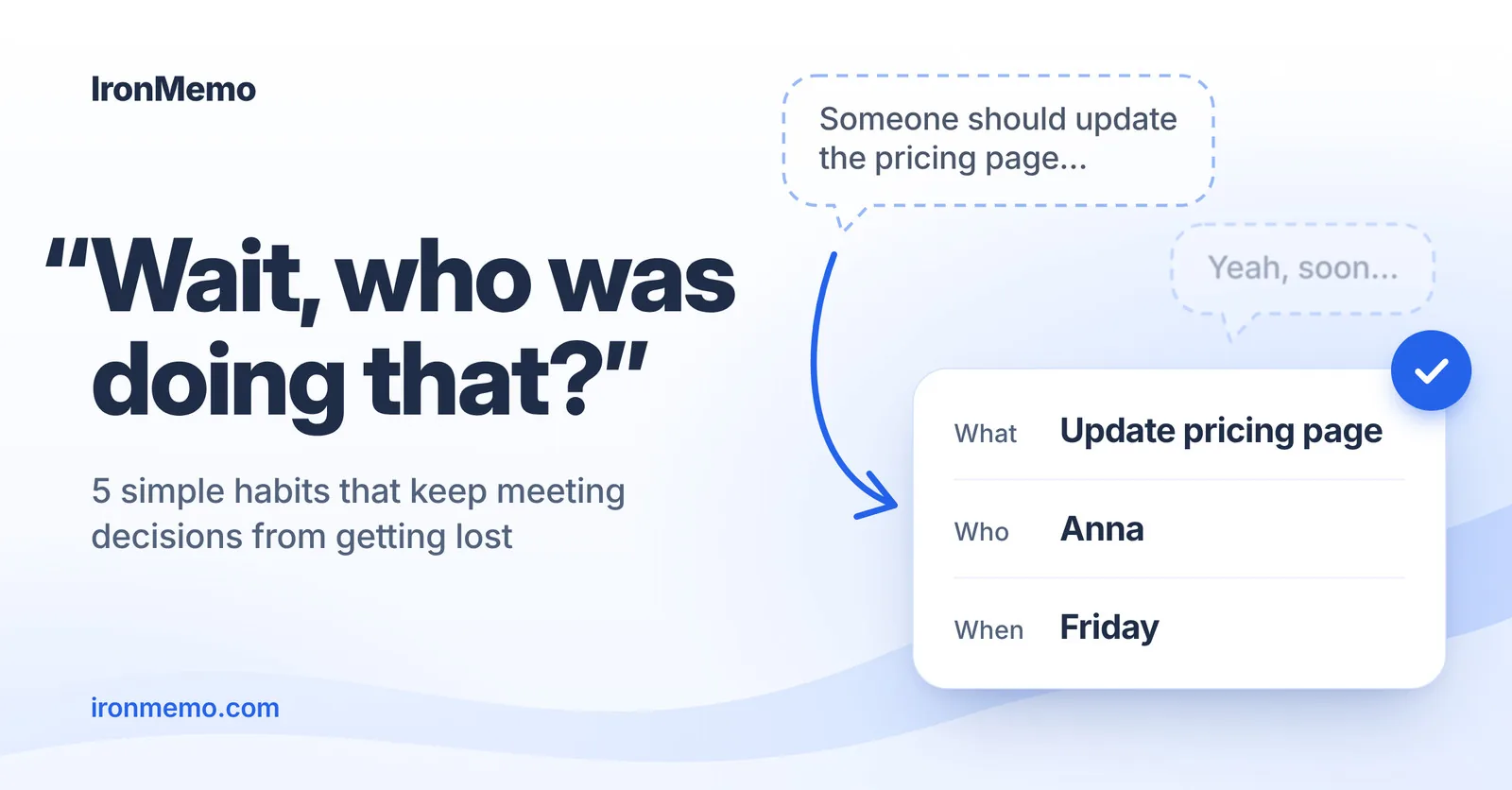
Why meeting decisions get lost, and 5 simple habits that keep them alive.
3-minute read
Monday, 10 a.m. The meeting goes well. Everyone agrees. Everyone nods. Someone says, “Great, let’s do it.”
Thursday, 4 p.m. Nothing has moved. Then somebody asks the question every team knows: “Wait, who was doing that?”
If this sounds like your team, relax. You are not lazy, and you are not alone.
It happens to most teams
Atlassian asked 5,000 office workers on four continents about their meetings. Two answers stand out:
- 54% often leave a meeting without a clear idea of the next steps, or who owns which task.
- 77% are often in meetings that end with a decision to schedule another meeting.
Microsoft heard something similar from 31,000 workers around the world. They named inefficient meetings as the number one thing that gets in the way of their work.
So the problem is not the people. It is the way meetings end.
Why good decisions disappear
You can’t listen and write at the same time. While you write down one point, you miss the next one. While you listen, your notes get holes.
Everyone remembers a different meeting. Five people leave the room with five slightly different versions of what was decided.
Nobody owns the notes. “Someone will send a summary.” Someone never does.
5 simple habits that fix it
1. Start with one sentence
Open the meeting with: “By the end, we need to decide ___.” If you can’t fill in the blank, you may not need the meeting.
In the same Atlassian survey, 79% of people said an agenda makes a meeting more productive. One sentence is the shortest agenda there is.
2. Say every decision out loud
When the group agrees on something, stop for five seconds and repeat it: “So we decided: the launch moves to July 1. Correct?”
It feels a little odd the first time. It also stops most “but I thought we agreed…” talks before they start.
3. Give every task a name and a date
A task without an owner is only a wish. Compare:
- A wish
“Someone should update the pricing page.” - A task
“Anna updates the pricing page by Friday.”
One task, one owner, one date.
4. Keep the last five minutes
Don’t squeeze in one more topic. Use the last five minutes to read the list back: what we decided, who does what, and by when. If something is unclear, this is the cheapest moment to fix it.
5. Send the summary the same day
A short message is enough: decisions, tasks, dates. The longer you wait, the more details fade, and the more those five versions of the meeting drift apart.
The hard part is doing it every time
None of these habits is difficult. The difficult part is keeping them up in every meeting, while you are also leading the talk, listening and thinking.
That is the job we built IronMemo for. It joins your Zoom, Google Meet or Microsoft Teams call, or you upload a recording. About a minute later you have a transcript, a clear summary, the key decisions and a list of tasks.
It works in 30+ languages, even when your team switches between them.
You focus on the meeting. AI takes the notes.
Free plan, no credit card.
Your checklist for the next meeting
- Open with one sentence: what do we need to decide?
- Say each decision out loud.
- Give each task one owner and one date.
- Use the last five minutes to read the list back.
- Send the summary the same day.
Try it for one week. Then count how often Thursday’s question comes up.
Where the numbers come from:
- Atlassian, “Workplace Woes: Meetings”, a survey of 5,000 knowledge workers
- Microsoft, Work Trend Index 2023, “Will AI Fix Work?”